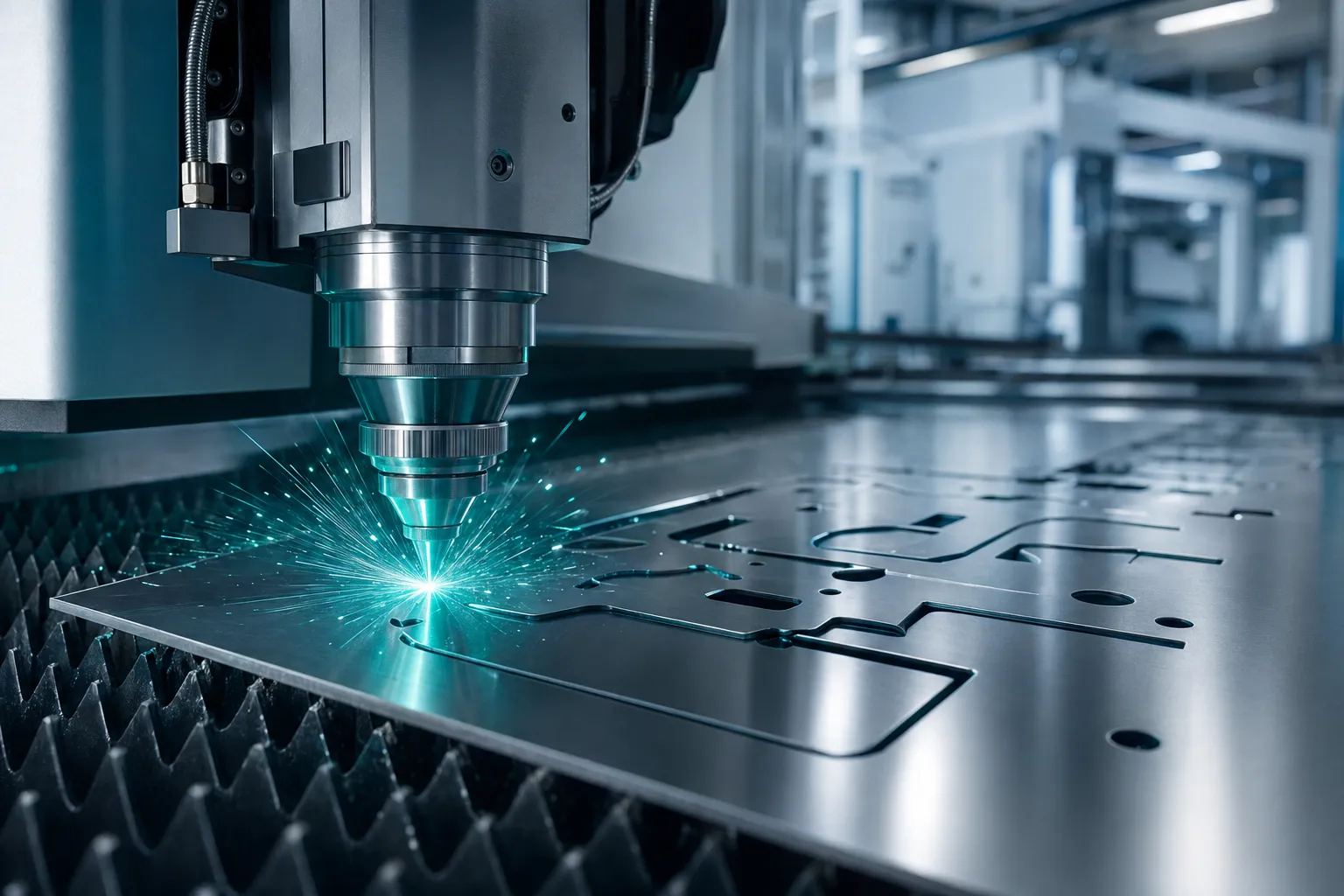
Cutting technology · Laser
CAD/CAM software for laser cutting machines.
CO₂, fibre and solid-state lasers. Trumpf, Bystronic, Amada, Mazak, LVD and others, all from one software, with more than 150 post-processor switches to match your machine.
Quick answer
FiNest handles CO₂, fibre and solid-state lasers on common machine platforms. Post-processors are available for Trumpf, Bystronic, Amada, Mazak, LVD and Prima Power, among others, as well as for HSG fibre lasers using the LXDS format. Key features: micro-joints to hold parts in place, an optimised machining sequence (up to 40 % shorter machining time compared with a non-optimised sequence), true-shape nesting with common-line cutting (up to 15 % less scrap compared with manual nesting) and edge lead-ins that save pierces at the sheet edge.
Background: Laser, plasma, oxy-fuel or waterjet: cutting processes compared
When it fits
When FiNest makes sense for laser cutting
- Several laser machines from different makers (a mix of Trumpf, Bystronic and Amada)
- High programming effort because order variants change constantly
- Quality problems on small contours and holes (burn marks, uneven edges)
- Material costs from manual nesting or unused remnants
- NC output that needs manual editing before it runs cleanly on the control
- A special or older laser control that needs a tailored post-processor
What FiNest offers for laser cutting
Automatic micro-joints
Micro-joints hold parts securely in the sheet. Position and size are matched to the contour and material, so there is little rework after cutting.
Optimised cutting sequence
Pierce-first, inner-before-outer and tool sorting are applied automatically in the post-processor. Up to 40 % shorter machining time compared with a non-optimised sequence.
Edge lead-in
The cut starts directly from the sheet edge without a separate pierce, saving time and material on the outer contour.
Dynamic feed rate
Corner slowdown and acceleration/deceleration profiles prevent burn marks and loss of quality on sharp contours.
True-shape nesting
AutoNest nests laser parts with common-line cutting and bridge cuts: up to 15 % less scrap compared with manual nesting.
Supported machines
Post-processors for these laser machines, among others
This list is not exhaustive. More than 150 configurable switches adapt FiNest to many standard and customer-specific laser machines. If your machine is not in the standard portfolio, we write a matching post-processor (usually 2–4 weeks, depending on scope).
Frequently asked questions
Which laser controls are supported?
Does FiNest work with fibre lasers?
Can we migrate existing Trumpf or Bystronic programs?
We have an HSG fibre laser with a CypCut control. Does FiNest work with it?
See it with your machine.
Live demo with your own parts, matched to your machine and control. 30–60 minutes, online or on site.